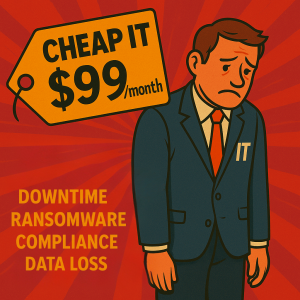
 You’ve seen the ads—flat-rate IT support for what looks like a steal. Maybe you’ve even signed on to one of those “budget-friendly” plans yourself.
And at first, everything seems fine.
But then, something breaks. The printer won’t talk to the network. A suspicious email slips through. Backups aren’t backing up what you thought they were. And suddenly, that bargain IT deal is costing you more in downtime, stress, and surprise fees than you ever expected.
Let’s pull back the curtain on what cheap IT really means—and why paying a little more for the right partner can save your business in the long run.
- Antivirus Is Not Enough
A lot of low-cost providers install basic antivirus and call it cybersecurity. But real protection? That includes things like multi-factor authentication (MFA), email filtering, ransomware detection, and training your team to spot threats.
Even worse—if these tools aren’t in place, your cyber insurance might not cover you when it matters most.
- Incomplete Backups Can Leave You Exposed
Many small businesses assume their email or cloud tools are being backed up automatically.
Spoiler alert: They’re not.
Basic systems like Microsoft 365 offer short-term recovery, but not the full backup and restoration capabilities needed to survive a cyberattack, system failure, or accidental deletion. And if your IT provider hasn’t set up proper, tamper-proof backups for all your critical data, you could be in for a nasty surprise.
- Surprise Fees Hurt More Than You Think
One of the oldest tricks in the book: lure you in with a low monthly rate, then nickel-and-dime you for every after-hours call or on-site visit.
That kind of pricing creates hesitation—should you call support or just try to “figure it out”? Every minute of delay leads to more downtime, more lost productivity, and more frustration.
- If It Touches the Network, It Should Be Covered
Phones, printers, internet, cameras—if it connects to your network, your IT partner should be willing to help when something goes wrong.
You shouldn’t have to manage vendor finger-pointing or pay extra just to get one company to talk to another. True support means taking ownership, not passing the buck.
- No Planning = Constant Firefighting
Some IT providers only fix what’s broken and never look ahead. That’s like having a mechanic who changes your oil but ignores the bald tires.
What you really need is someone thinking ahead: planning for upgrades, preparing for compliance changes, and making sure your systems grow with your business. That’s the role of a true IT partner—not just a help desk.
Final Word: Peace of Mind Matters More Than Price
If your current IT setup leaves you unsure, unsupported, or stuck with surprise bills, it might be time for a second opinion.
We offer a free IT risk review with no pressure, no jargon—just an honest look at where things stand and how to fix what’s falling through the cracks.
Because you’ve got enough on your plate already. Let’s make IT one less thing to worry about.